Tennis Court Installation
Professional tennis court installations built for consistent play, excellent surface quality, and long-lasting performance.
New Tennis Court Installation
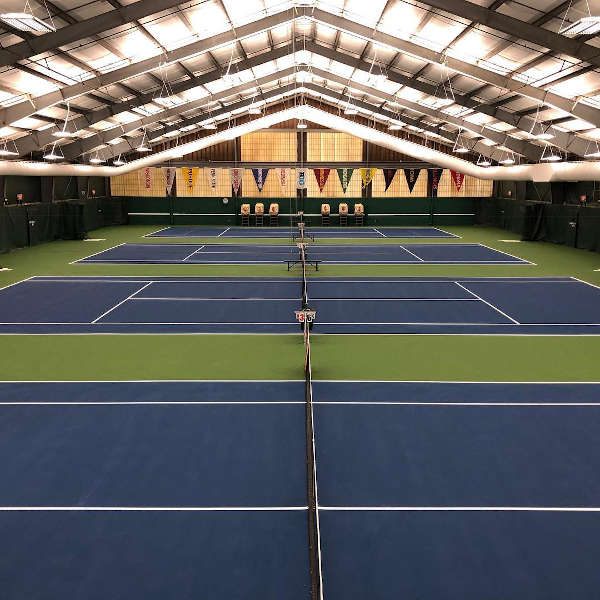
Installing a tennis court can be an exciting yet intricate project that requires specialized knowledge, precision, and experience. Whether you’re a homeowner looking to bring the game closer to home, a school in need of sports facilities, or a commercial setting looking to offer premium amenities, a tennis court serves as a long-lasting investment in fun, fitness, and even community well-being. From surface type selection to professional installation techniques, every detail matters in ensuring that your tennis court serves you for years.
With over 20 years in the business, we pride ourselves on delivering exceptional customer service and a superb final product. Our expertise spans a variety of settings, including homes, schools, parks, and commercial establishments across Indiana. We believe that a top-quality tennis court is more than just a surface to play on; it’s a lifetime of rallies, matches, and memories waiting to be made.
How Much Room for a Tennis Court?
The amount of space needed for a tennis court can vary depending on several factors, including the type of court, its purpose, and whether it will include additional amenities like seating areas, fencing, or lighting. However, some standard dimensions can serve as a general guide.
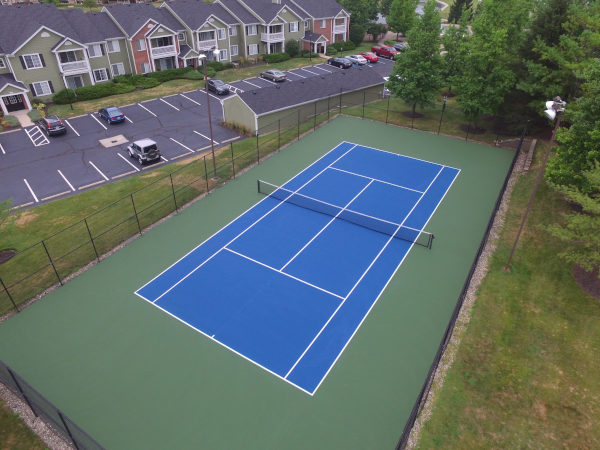
A standard regulation singles tennis court measures 78 feet long and 27 feet wide, while a doubles court is 78 feet long and 36 feet wide. These measurements are for the playing area and do not include space for drainage, fencing, or walking areas around the court.
For a comfortable playing environment and to accommodate all these additional elements, consider a total area of at least 120 feet by 60 feet. This allows for:
– 21 feet of space behind each baseline (making the length 120 feet)
– 12 feet of space on each side of the court (making the width 60 feet for a doubles court)
When designing and installing your court, AG Sports Surfaces will work with you to ensure that the space you have meets your needs and maximizes your court’s functionality.
CALL 765-586-5332 FOR A FREE ESTIMATE
How Much Does a Tennis Court Cost?
The cost of installing a tennis court can vary significantly based on various factors, such as the type of surface material, location, labor costs, and any additional amenities like lighting, fencing, or a drainage system. Here are some ballpark figures to give you an idea of what different types of courts might cost:
– Asphalt Hard Courts: $50,000 to $80,000
– Clay Courts: $25,000 to $60,000
– Grass Courts: $15,000 to $45,000
– Synthetic Courts: $35,000 to $100,000
These are just starting points, and the costs can fluctuate depending on the specifics of your project. For instance, installing a high-end cushioned acrylic hard court with professional-grade lighting and fencing can quickly push costs upwards of $100,000.
Additional expenses could include:
- Site preparation costs
- Fencing
- Lighting
- Amenities
- Permits and Legal Fees
AG Sports Surfaces we offer a customized approach to each project, taking into account your specific needs, preferences, and budget constraints. With over 20 years of experience in Indiana, we know how to deliver a high-quality tennis court that offers excellent playability and durability. Before beginning any project, we provide a detailed cost breakdown and timeline, ensuring no surprises along the way. You’ll find that investing in a well-constructed tennis court adds not just monetary value to your property but also a lifetime of enjoyment and fitness benefits.
CALL 765-586-5332 FOR A FREE ESTIMATE
What are the different kinds of tennis courts, and what are the pros and cons?
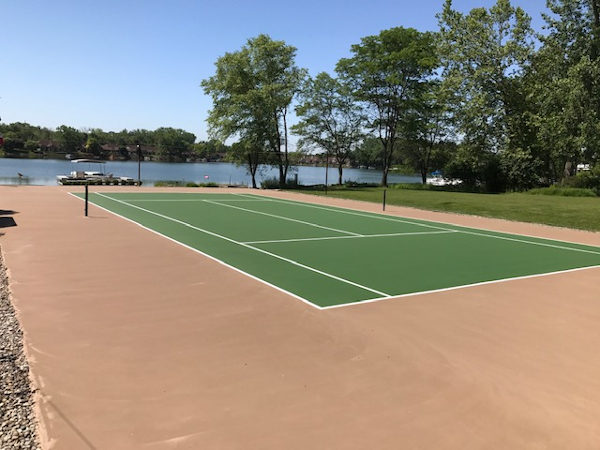
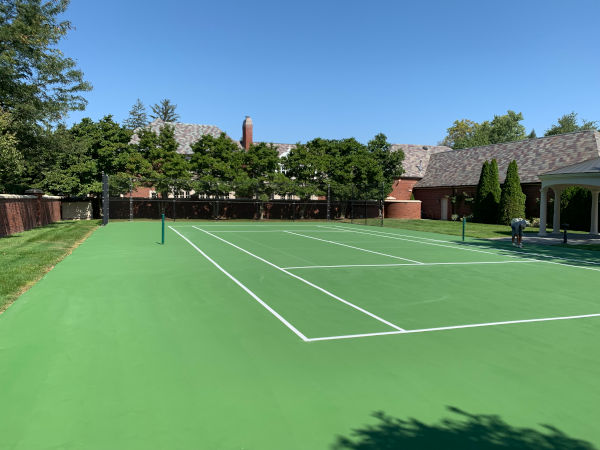
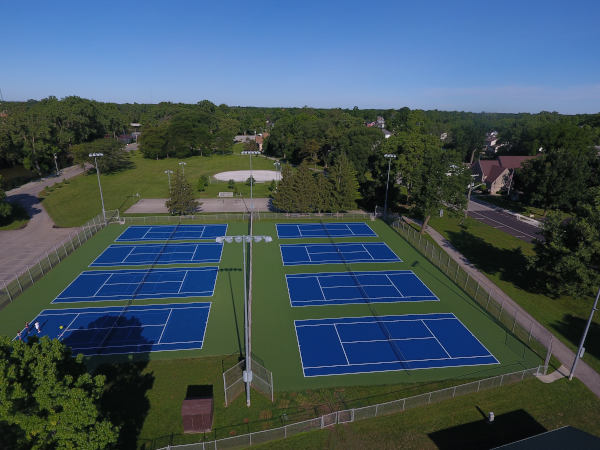
Hard Courts
Pros:
- Durability: Hard courts are long-lasting and require less frequent maintenance than clay or grass.
- Consistent Play: These courts offer a uniform bounce and are less affected by weather conditions.
- Versatile: Suitable for players of all skill levels.
Cons:
- Impact on Joints: The hard surface can be tough on players’ knees and ankles over time.
- Cost: Generally more expensive to install compared to clay courts but less than some other types like cushioned synthetic courts.
Clay Courts
Pros:
- Slower Ball Speed: Allows for longer rallies and a more strategic game.
- Less Impact: The softer surface is easier on the joints than hard courts.
- Natural Material: Offers a traditional, “authentic” tennis experience.
Cons:
- Maintenance: Requires regular watering, rolling, and sweeping.
- Weather-Sensitive: Can become too soft when wet, affecting playability.
- Variable Bounce: Surface irregularities can result in inconsistent ball bounce.
Grass Courts
Pros:
- Fast Play: The ball skids more, making for quicker points.
- Iconic: Offers a classic, Wimbledon-like playing experience.
- Joint-Friendly: The soft surface minimizes impact on joints.
Cons:
- High Maintenance: Requires regular mowing, watering, and reseeding.
- Seasonal: Not ideal for year-round play in most climates.
- Inconsistent Bounce: Ball behavior can be unpredictable, especially when the grass is worn or uneven.
Synthetic Courts
Pros:
- Versatility: Can mimic the characteristics of clay or hard courts.
- Low Maintenance: Generally easier to maintain than clay or grass.
- Weather-Resistant: Good for a variety of climates and less affected by rain.
Cons:
- Cost: It can be expensive to install, especially for high-end cushioned systems.
- Surface Wear: The synthetic material may need resurfacing or replacement over time.
CALL 765-586-5332 FOR A FREE ESTIMATE
Asphalt Tennis Courts vs. Concrete Tennis Courts
When it comes to hard court tennis installations, the choice often boils down to asphalt versus concrete, each with its unique advantages and drawbacks. Asphalt courts offer flexibility, making them less prone to cracking due to ground movement or temperature changes. This material is generally more cost-effective for initial installation and provides a slightly softer impact on joints. However, asphalt’s softer nature means it may require more frequent resurfacing and can be sensitive to extreme heat.
Concrete courts, on the other hand, stand out for their durability and low maintenance needs. These courts offer a consistent, uniform bounce, ideal for competitive play. However, the hardness of concrete can be tough on players’ joints over time, and initial installation costs are usually higher. Additionally, while concrete is long-lasting, it’s not immune to cracking due to environmental factors, requiring occasional repairs.
CALL 765-586-5332 FOR A FREE ESTIMATE
WHY CHOOSE AG SPORTS SURFACES?
Creating or revitalizing an outdoor basketball court is more than just a construction project; it’s an investment in a space where people come together, where athletes grow, and where communities are strengthened. Whether you’re embarking on a new installation or breathing life back into an existing court through resurfacing and painting, the choices you make today will impact countless games, tournaments, and casual shootarounds for years to come. That’s why it’s crucial to partner with experts who can guide you through each phase, ensuring a result that exceeds your expectations in both quality and performance.
With over 20 years of experience in sports surface installations and resurfacing, AG Sports Surfaces has the expertise and passion to make your outdoor basketball court vision a reality. Based in Indiana, we’re committed to exceptional craftsmanship and customer service, aiming to provide a court that serves as a long-lasting asset to your home, school, or commercial space.
Ready to take the next step? Contact us today to discuss your specific needs and learn how we can transform your outdoor space into a basketball court you’ll be proud of. Let’s make your dream court come to life.
- Owner-Involved Service
- Indiana Tested Durability
- Custom Design Options