
Generally, no. In most cases, a tennis, pickleball, or basketball court that an Indiana homeowners association maintains for residents and their invited guests is not considered a place of public accommodation, and Title III of the Americans with Disabilities Act is commonly understood not to apply to it.
That general position tends to change when the court is opened to people outside the community. It also does not address two Indiana-specific layers that apply regardless: the Indiana Fair Housing Act at IC 22-9.5, and the accessibility scoping built into the Indiana Building Code.
Roughly 5,250 community associations operate in Indiana, housing about 880,000 residents across 355,000 units, according to the Foundation for Community Association Research. A large share of them own courts that were designed and poured long before accessible routes were a regular part of the conversation at the board table.
This article outlines how these questions are generally approached in Indiana, which state agencies are involved, and what accessibility typically involves at the pavement level.
Disclaimer: This article is general information only, current as of the publication date (09/2026), and is not legal advice or a compliance determination for any property. Statutes, administrative rules, and adopted code editions change over time and vary by jurisdiction and by the facts involved. Associations should consult qualified Indiana legal counsel and their local building department regarding their own circumstances.
Three Layers of Rules Apply to Indiana HOA Courts
Most board discussions treat this as a single ADA question. In Indiana it is generally more useful to separate it into three layers, because they are triggered by different things and enforced by different bodies.
| Layer | What generally triggers it | Who typically handles complaints |
|---|---|---|
| ADA Title III (federal) | The court being made available to the general public | U.S. Department of Justice, private suits in the Northern or Southern District of Indiana |
| Fair housing, federal and Indiana (IC 22-9.5) | Covered multifamily dwellings, plus accommodation and modification requests | HUD and the Indiana Civil Rights Commission |
| Indiana Building Code (675 IAC 13-2.6) | New construction, additions, and many alterations at permit or design release | Local building department and Indiana Department of Homeland Security |
An association can sit entirely outside the first layer and still be squarely inside the third. This is the distinction we see boards miss most often when planning a court project.
The Short Answer: It Generally Depends on Who Uses the Court
ADA Title III applies to places of public accommodation. The residential and recreational facilities of a private common interest development generally do not fall into that category, provided use is limited to members, residents, and their invited guests.
Bringing a guest is not typically viewed as converting an amenity into a public accommodation. Selling or granting broader access to the public is more commonly seen as doing so.
The table below summarizes how these scenarios are generally characterized. It is a starting point for discussion with counsel rather than a determination of any particular association position.
| How the court is used | Is ADA Title III generally viewed as applying? | What is often also relevant |
|---|---|---|
| Residents and their invited guests only | Generally no | IC 22-9.5, reasonable accommodation duties, Indiana Building Code at permit |
| Non-residents buy memberships, day passes, or court time | Commonly yes | ADA Title III alongside fair housing considerations |
| A school, church, club, or league uses the courts on a regular basis | Commonly yes | ADA Title III alongside fair housing considerations |
| Tournaments or meets open to public spectators | Often yes, at least for that use | ADA Title III considerations for the event |
| On-site leasing, sales, or management office open to the public | Frequently yes | ADA Title III considerations for the office and its path of travel |
| Association-maintained sidewalks used by the general public | Often yes | ADA Title III considerations for the public route |
Characterizations above reflect general patterns described in widely available guidance. They are not predictions about how any specific set of facts would be resolved under Indiana or federal law.
What May Turn an Indiana HOA Court Into a Public Accommodation
Arrangements that open the court to the general public are the ones most frequently identified as raising ADA questions, even when the public use is part-time. The emphasis in most guidance is on access rather than frequency.
These are among the fact patterns that attorneys and management companies most commonly flag for review:
- Selling memberships, day passes, or reservable court time to non-residents
- Allowing outside schools, churches, clubs, or leagues to use the courts on a recurring basis
- Hosting tennis or pickleball events with spectator access open to the public
- Operating a rental, sales, or management office on the property that regularly receives the general public
- Renting the clubhouse and adjacent amenity area for events open to non-residents
This comes up frequently in Indiana because of pickleball demand. Courts that sat quiet for a decade are now drawing organized play, and open signup groups can expand well past the neighborhood before a board ever votes on it.
“We see this most in the Indianapolis suburbs. A neighborhood adds pickleball lines, a local group starts a standing Saturday game, and within a season half the players live somewhere else. Nobody made a decision, it just grew.“
– AG Sports Surfaces, court construction team
The Indiana Fair Housing Act Applies Even Where the ADA Does Not
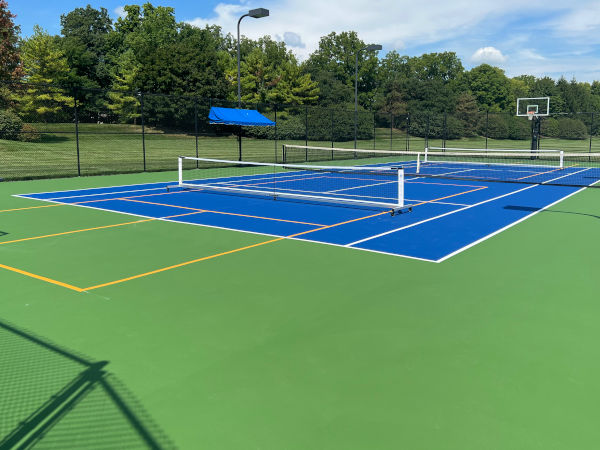
Indiana maintains its own fair housing statute at IC 22-9.5, which parallels the federal Fair Housing Act and was written to provide rights and remedies substantially equivalent to federal law.
IC 22-9.5-5-5 addresses disability discrimination and, in connection with the design and construction of covered multifamily dwellings, describes public use and common use parts as needing to be readily accessible to and usable by persons with disabilities. That common use category is generally read to include parking areas, walkways, and outdoor recreational areas, which is where courts usually sit.
The statute also contains a provision Indiana boards should know about. IC 22-9.5-5-5(e) indicates that compliance with the rules of the Fire Prevention and Building Safety Commission incorporating ANSI A117.1 satisfies the related accessibility requirement. In practical terms, the state building code and the state fair housing statute are designed to line up rather than conflict.
Who Handles Fair Housing Complaints in Indiana
The Indiana Civil Rights Commission administers IC 22-9.5 and investigates housing discrimination complaints in the state, with procedures set out at 910 IAC 2. Complaints may also be filed federally with HUD.
Indiana law also recognizes veteran status as a protected class in housing alongside the federal categories, under the Indiana Civil Rights Law at IC 22-9 and the fair housing article. That difference does not usually change an accessibility analysis, but it is worth knowing that the Indiana list is not identical to the federal one.
Two Points Indiana Boards Regularly Get Wrong
Detached single-family homes and duplexes are generally not treated as covered multifamily dwellings. Many Indiana subdivisions of single-family homes with a shared amenity area would typically sit outside the design and construction rules, though reasonable accommodation and modification considerations may still be relevant.
Common areas predating March 13, 1991 are generally not subject to retrofit under those same design and construction rules. New construction is usually viewed differently, so a newly built court, clubhouse, or amenity lot in an Indiana community is more likely to be treated as covered common use space from the start.
The Indiana Homeowners Associations Act and Internal Grievance Steps
Indiana associations have one procedural feature that boards in other states do not, and it can matter when an accessibility concern is raised by a resident rather than by a regulator.
The Indiana Homeowners Associations Act at IC 32-25.5 generally applies to associations established after June 30, 2009 that are authorized to impose mandatory dues, and older associations may elect to be governed by it. The Act addresses budgets, records, meetings, amendments, and grievance resolution procedures in governing documents.
Where those grievance provisions apply, disputes between a member and the association are generally expected to move through the association internal process before legal proceedings begin. A resident raising a concern about court access may therefore start inside your own governing documents rather than with an agency.
What Accessibility Typically Involves at a Sports Court
Where the standards do apply, they are generally read to call for an accessible route to the boundary of the court and, for court sports, a route connecting both sides of the court. Requirements are generally understood not to extend inside the playing lines.
Section 206.2.2 of the 2010 ADA Standards for Accessible Design, and its advisory, describe basketball courts, tennis courts, running tracks, and similar spaces as areas of sport activity that an accessible route should connect to at the boundary. The advisory indicates that where multiple courts are provided, a route is expected to each one.
Section 206.2.12 addresses court sports specifically, stating that at least one accessible route shall directly connect both sides of the court. Guidance published by the U.S. Access Board explains the reasoning, noting that players should not be required to travel through a neighboring court to reach the far side of their own, which is particularly relevant in tennis where changing ends is part of play.
The Access Board guidance also indicates that no additional accessibility provisions apply once a player is on the playing surface. This point is one of the most frequently misunderstood in HOA discussions about accessible courts.
Specifications Commonly Referenced in Court Design
The figures below reflect what the published standards state. Indiana projects typically also reference ICC A117.1-2009, adopted through the state building code, which covers much of the same ground. Whether and how these apply to a given project generally depends on scope, jurisdiction, and plan review.
| Element | As stated in the 2010 ADA Standards | Where it commonly comes up |
|---|---|---|
| Accessible route clear width | 36 inches minimum | Perimeter walkways and gate approaches |
| Pinch point exception | 32 inches for up to 24 inches of length | Gate posts, fence returns, bollards |
| Gate or doorway clear opening | 32 inches minimum, measured at 90 degrees | Single swing gates in chain link fence |
| Running slope of a walkway | 1:20 (5%) maximum before ramp provisions apply | Sloped approach from the amenity lot |
| Ramp slope | 1:12 (8.33%) maximum | Grade changes a walk cannot absorb |
| Cross slope | 1:48 (2.08%) maximum | Walks that follow the court drainage fall |
| Change in level | Over 1/2 inch addressed by ramp or curb ramp | Court edge to adjacent walkway |
| Passing space | 60 by 60 inches at intervals no greater than 200 feet | Fence-line paths under 60 inches wide |
| Surface | Firm, stable, and slip resistant | Gravel, mulch, and turf approaches often fall short |
| Operating hardware | One hand, no tight grasping, pinching, or twisting | Gate latches and padlock hasps |
Parking scoping is set out in Section 208.2, which provides one accessible space for lots of 1 to 25 spaces, two for 26 to 50, and three for 51 to 75. One of every six accessible spaces is designated van accessible, with a 96 inch access aisle rather than the standard 60 inches.
In our experience building these projects across Indiana, the constraint is rarely the court itself. It is usually the stretch of ground between the parking area and the gate.
Why Indiana Weather Complicates Accessible Routes
This is the part of the conversation that is specific to Indiana rather than borrowed from national guidance. An accessible route that met tolerance the day it was poured can move.
Central Indiana pavement contractors commonly report 100 or more freeze-thaw cycles per year, and the Indiana State Climate Office at Purdue tracks these events using hourly data from Indianapolis International Airport. National Weather Service normals for Indianapolis show 43.63 inches of annual precipitation and 27 days a year with highs at or below freezing.
The tolerances involved are tight. A 2.08 percent maximum cross slope leaves very little room, so a walkway panel that heaves or settles a half inch over a few winters can drift out of the range it was built to. Changes in level over half an inch at a panel joint are a common finding on older Indiana amenity walks.
The practical implications are straightforward. Base preparation and drainage on the approach walk generally matter as much as the initial dimensions, and periodic re-measurement is usually more reliable than assuming an installed route stays where it started.
Poor drainage is frequently the underlying cause. Our guide to sports court drainage requirements covers how water movement around a court affects the pavement beside it.
Existing Courts and the Readily Achievable Concept
Where a court is treated as a public accommodation and predates current standards, the general expectation described in the regulations is that architectural barriers are removed where doing so is readily achievable, a phrase defined as easily accomplishable and able to be carried out without much difficulty or expense.
The Department of Justice regulation at 28 CFR 36.304 lists illustrative examples, including installing ramps, making curb cuts, and widening doors. What is considered readily achievable is generally understood to scale with available resources and to be revisited over time, so a measure that seems out of reach in one Indiana association budget cycle may be viewed differently after a reserve contribution increase.
An element-by-element safe harbor may also be relevant. Under that provision, elements that have not been altered on or after March 15, 2012, and that complied with the 1991 Standards, are generally not required to be brought up to the 2010 Standards.
Where Resurfacing Tends to End and Alteration Tends to Begin
Routine resurfacing is generally treated as maintenance. Rebuilding the slab, changing the footprint, adding courts, or reconfiguring a tennis court into multiple pickleball courts is more commonly viewed as an alteration, which is typically associated with stronger accessibility expectations.
This distinction is widely regarded as one to settle before a project goes out to bid rather than after. Indiana associations weighing a tennis to pickleball conversion are generally advised to raise the accessibility question with counsel and their local building department during design.
Indiana Building Code and the Design Release Question
Indiana applies accessibility scoping through its state building code, and that framework generally operates independently of how any ADA analysis comes out. For many associations this is the layer that actually governs a project.
The Indiana Building Code at 675 IAC 13-2.6 adopts the 2012 International Building Code with Indiana amendments and references ICC A117.1-2009 as the technical accessibility standard. IBC Chapter 11 generally supplies the scoping, meaning what is expected to be accessible, while A117.1 supplies the dimensional criteria.
Class 1 Structures and State Plan Review
Indiana adds a step that surprises boards coming from other states. IC 22-12-1-4 defines a Class 1 structure broadly, generally covering buildings used in any part by the public, by three or more tenants, or by employees of another. Multifamily buildings and commercial amenity buildings commonly fall into this category, along with their accessory structures.
Under 675 IAC 12-6-3, construction on a Class 1 structure generally requires a design release issued by the state before work begins, unless the project falls within an exemption listed at 675 IAC 12-6-4. Design releases are handled through Indiana Department of Homeland Security building plan review.
Whether a particular outdoor court, walkway, or site improvement requires a design release depends on the specific scope and on how it relates to other work. That determination is generally best confirmed with IDHS plan review and your local building department rather than assumed either way.
Local review still applies on top of the state process. Plan reviewers in growing Indiana communities may require an accessible route as a condition of approval, so contacting the city or county building department during design rather than after bid award is generally advisable. Code editions and local amendments change, so confirm current requirements with the authority having jurisdiction.
Where This Question Comes Up Most in Indiana
Two patterns drive most of the calls we get on this subject, and they tend to cluster geographically.
The first is newer amenity-heavy development in the Indianapolis growth corridor, including Hamilton County communities in Carmel, Fishers, Noblesville, and Westfield, along with Boone, Hendricks, and Johnson County subdivisions. These communities were generally built after the 1991 fair housing design and construction threshold, which means the common use area rules are more likely to be part of the analysis from the beginning.
The second is established associations with aging courts in Indianapolis, Fort Wayne, Bloomington, Lafayette, Evansville, and South Bend. Here the court often predates current standards, the approach path may have been an afterthought, and the question usually surfaces when the board starts planning a rebuild or a pickleball conversion.
We work throughout the state. See our Indiana sports court services, or local pages for Carmel, Fishers, Bloomington, and Lafayette.
A Suggested Accessibility Review for Indiana HOA Boards
The following is a general planning sequence that many Indiana boards find useful. It is not a compliance determination and does not substitute for review by counsel.
- Document who actually uses the court. Recording non-resident use over the past 24 months, including leagues, camps, schools, clinics, and open events, generally gives counsel the factual basis they need.
- Identify your first occupancy dates. Buildings with four or more units first occupied after March 13, 1991 are commonly the ones where federal and Indiana fair housing design and construction provisions come into the discussion.
- Check your governing documents for grievance resolution procedures. Where IC 32-25.5 applies, those internal steps are generally where a resident concern is expected to start.
- Walk the route with a tape measure and a smart level. Recording clear width at the narrowest point, cross slope, gate clear opening at 90 degrees, and changes in level over half an inch is generally a useful starting inventory. Re-measuring every few years is advisable given Indiana freeze-thaw movement.
- Photograph anything that looks short of the referenced dimensions. Boards tend to act on what they can see, and photographs usually move a budget discussion faster than a memo.
- Call your local building department, and IDHS plan review if a design release may be involved, before scoping any construction work.
- Price potential improvements and consider staging them. Lower-cost items such as latch hardware and stall striping are often handled in an operating budget rather than deferred to a reserve study.
- If the board prefers to keep courts resident-only, it is generally recommended that the position be adopted as a written rule and applied consistently. A policy that is not enforced is widely considered weaker support.
Accessible Design Is Often Worthwhile Regardless of Obligation
About 1,428,132 Indiana adults live with a disability, roughly 1 in 4, and 14 percent of Hoosier adults report a mobility disability involving serious difficulty walking or climbing stairs, according to CDC state profile data for Indiana.
Those figures describe the resident population Indiana associations already serve. In a community of 300 homes, it is reasonable to expect a meaningful number of adults who would find a 6-inch curb between the parking pad and the gate difficult.
Litigation exposure is frequently raised in these discussions, though it is generally a secondary consideration for residential associations. For context, plaintiffs filed 8,667 ADA Title III lawsuits in federal court nationally in 2025 according to tracking published by Seyfarth Shaw, and Indiana federal courts recorded 48 such filings in the first half of 2025.
The more common driver we see is usage. Courts that residents can reach easily with a walker, a wheelchair, or a stroller tend to get used more, and amenity usage is typically what Indiana boards point to when defending an assessment.
Frequently Asked Questions
Does an Indiana HOA tennis court have to be ADA accessible?
Generally not, though it depends on the facts. Where a court is used only by residents and their invited guests, it is typically not treated as a place of public accommodation, and ADA Title III is commonly understood not to apply. Where an association sells access to non-residents or hosts public events, Title III is more likely to be considered relevant. Separately, the Indiana Building Code and the Indiana Fair Housing Act may apply regardless of public use.
Our Indiana HOA rents the courts to a pickleball league on weeknights. Does that change anything?
It may. Regular use by an outside club or league is among the scenarios most commonly identified as raising public accommodation questions, even where the use is part-time. In that situation, the barrier removal concepts described in 28 CFR 36.304 are generally worth reviewing with Indiana counsel.
Who handles fair housing complaints about accessibility in Indiana?
The Indiana Civil Rights Commission administers the Indiana Fair Housing Act at IC 22-9.5 and investigates housing discrimination complaints in the state, with procedures at 910 IAC 2. Complaints may also be filed federally with HUD. Where the Indiana Homeowners Associations Act applies, governing document grievance procedures are generally expected to be used first for disputes between a member and the association.
Does an Indiana HOA court project need a state design release?
It depends on the scope. Indiana generally requires a design release from the state before construction on a Class 1 structure under 675 IAC 12-6-3, with exemptions listed at 675 IAC 12-6-4, and Class 1 is defined broadly at IC 22-12-1-4. Whether a specific court, walkway, or site improvement falls inside that requirement is best confirmed with Indiana Department of Homeland Security plan review and your local building department.
Our Indiana neighborhood was built in 1985. Do we have to retrofit the courts?
Generally not under the federal or Indiana fair housing design and construction provisions, which are directed at covered multifamily dwellings first occupied after March 13, 1991. Reasonable accommodation and modification considerations may still apply, and if courts come to be treated as a public accommodation, the readily achievable barrier removal concept is typically discussed regardless of build date.
Does the playing surface itself have to meet ADA standards?
Generally no. The 2010 Standards describe an accessible route to the boundary of the area of sport activity and, in court sports, a route connecting both sides of the court. Published guidance indicates that additional accessibility provisions are not applied once a player is inside the playing lines.
How wide does a gate on an accessible court need to be?
The 2010 Standards state a minimum clear opening of 32 inches measured with the gate open 90 degrees, with connecting routes described as 36 inches minimum clear width. A standard 36-inch chain link gate will often clear that, but hinges, latch posts, and self-closing devices reduce the usable opening, so measuring the actual clear width rather than the frame size is generally recommended.
Can an Indiana board just post a sign saying the courts are for residents only?
A board-adopted, written, consistently enforced policy limiting use to residents and guests is generally regarded as stronger support for a resident-only position than signage alone. Signage tends to carry little weight where an association continues approving outside bookings. Keeping the policy in the governing documents or rules and maintaining a use log is a common recommendation.
Planning an HOA Court Project in Indiana?
AG Sports Surfaces has been building courts for Indiana conditions since 2015. We build and rebuild sports courts, tennis courts, pickleball courts, and basketball courts for homeowners associations, schools, parks departments, and private clients throughout the state.
We handle site grading, approach walkways, fencing and gates, acrylic surfacing, and striping as a single scope, so the route and the court are generally designed together rather than added on afterward. Review our service areas or contact us for a free estimate. You can also call us directly at 765-586-5332.