
Building a pickleball court near homes in Indiana requires careful planning around zoning, noise, surface selection, drainage, and neighbor relations. Get these factors right, and you’ll have a court that adds value, enjoyment, and community. Get them wrong, and you risk permit violations, neighbor disputes, and a playing surface that deteriorates within a few seasons.
According to USA Pickleball, over 4,000 new pickleball locations were added across the country in 2024 alone, contributing to nearly 16,000 new courts nationwide. Indiana has been part of that growth, with residential and community courts appearing in neighborhoods from Indianapolis suburbs to rural farmland.
At AG Sports Surfaces, we’ve built and resurfaced courts across Indiana for years. We understand the local climate, the regional permitting landscape, and what it takes to build a court that lasts. Below are the most important factors to consider when building a pickleball court near homes in Indiana.
Zoning, Permits, and HOA Approval in Indiana
The first step before breaking ground is confirming your property is properly zoned for a recreational court and determining whether a building permit is required. Indiana is a home rule state, which means permit requirements vary significantly by county and municipality.
Many residential zoning ordinances classify sports courts as “accessory structures.” That classification triggers setback requirements from property lines, height limits for fencing and lighting poles, and sometimes a formal site plan review. In cities like Indianapolis and Carmel, the permitting process is well-defined. In rural Indiana counties, enforcement may be more limited, but the statewide residential code still technically applies.
Key questions to answer before you start:
- Is a building permit required in my county or city?
- What are the setback requirements from property lines and existing structures?
- Does my HOA allow sports courts, and what approval process is required?
- Are there restrictions on fencing height or lighting in my zoning district?
If you’re in a neighborhood with a homeowners’ association, you’ll likely need written approval from the HOA board before construction begins. Submit your plans early, including the court layout, fencing specifications, and lighting plans. This gives the HOA time to review everything and reduces the chance of costly changes later. Working with a professional court builder simplifies the permitting process significantly.
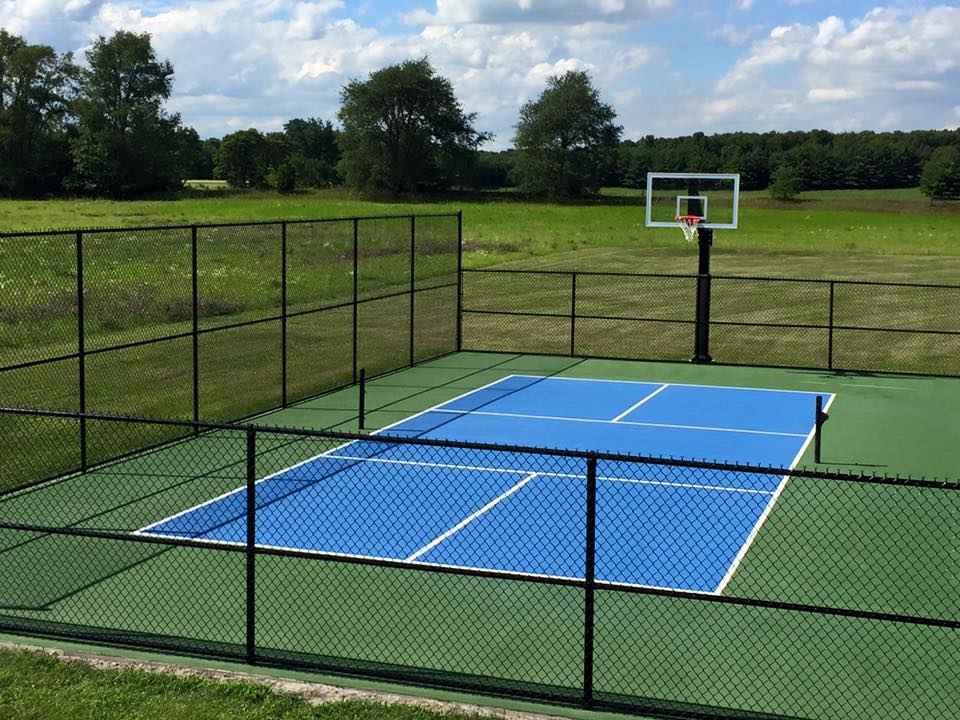
Court Placement and Orientation
Where you position your court on your property directly affects playability, neighbor impact, and long-term satisfaction. Two factors matter most: sun orientation and distance from neighboring homes.
Sun Orientation
According to USA Pickleball’s official construction guidelines, outdoor courts should be oriented with the long axis running north-south whenever possible. This minimizes the chance that players will be looking directly into the sun during morning or late-afternoon play. In Indiana, the sun tracks lower in the winter sky and higher in summer, so a north-south orientation works well year-round.
Distance from Neighboring Homes
The further the court is from neighboring homes, the better for both noise reduction and maintaining good relationships. Position the court so that the “active” playing areas near the non-volley zone (where most quick paddle exchanges happen) face away from the nearest homes.
Acoustic engineering research recommends a minimum setback of 100 feet from the nearest residential property line for private courts, with 150 feet preferred for community or HOA facilities. At 200 feet or more, noise complaints drop significantly even without additional barriers. Managing pickleball court noise starts with smart placement.
Drainage and Slope Requirements
Court surfaces must drain properly to prevent water pooling, surface damage, and slippery play conditions. Indiana’s spring rains and occasional heavy thunderstorms make drainage planning essential for any outdoor court.
The ideal court has a slight slope of roughly 1% gradient (about 1 inch per 10 feet) that allows water to run off the sides without creating low spots. This slope is subtle enough that players won’t notice it during play but effective enough to clear standing water within minutes of a rainstorm.
Consider where that runoff goes. You don’t want to channel water toward a neighbor’s property or toward your home’s foundation. Proper grading during site preparation is critical, and understanding court drainage requirements will help you avoid costly mistakes.
Noise Management for Residential Pickleball Courts
Noise is the single most common friction point between pickleball court owners and their neighbors. Understanding why pickleball sounds carry so far helps you plan effective mitigation from the start.
Research from acoustics professionals shows that a pickleball paddle striking the ball produces sound in the 1,000 to 2,000 Hz frequency range, which is exactly where human hearing is most sensitive. A typical paddle impact registers approximately 70 dBA at a distance of 100 feet from the court. For comparison, normal conversation measures about 60 dBA and a lawn mower reaches roughly 90 dBA.
The issue isn’t raw volume. It’s the sharp, percussive quality of the sound combined with its rhythmic repetition during rallies. This makes pickleball noise more noticeable to neighbors than other outdoor activities at the same decibel level.
Practical steps to manage noise near homes:
- Position the court as far as possible from neighboring homes and outdoor living areas
- Install acoustic fencing or dense windscreen on the sides of the court facing neighbors
- Plant fast-growing evergreen trees like arborvitae as a natural sound buffer
- Set reasonable use hours and communicate them with neighbors
- Consider quieter paddle options if noise becomes an ongoing concern
Properly designed acoustic barriers can reduce noise by 10 to 25 dBA at nearby homes, depending on barrier height, material, and placement. Getting ahead of noise concerns before a neighbor complains is far easier than addressing them after the fact.
Surface Selection and Quality
The surface is the foundation of any pickleball court. For courts near homes in Indiana, you have two primary base options: asphalt and concrete. Each has distinct advantages depending on your budget, timeline, and long-term goals.
| Factor | Details |
| Asphalt Base | Most common for outdoor pickleball courts in Indiana. Cost-effective, installs relatively quickly, and handles freeze-thaw cycles reasonably well when properly installed. Requires resurfacing every 7 to 10 years. Base preparation and asphalt mix quality matter enormously. |
| Concrete Base | Higher upfront investment but lasts longer with less ongoing maintenance. More dimensionally stable than asphalt in temperature extremes. Control joints must be placed correctly to prevent cracking from Indiana’s freeze-thaw cycles. Can last 25+ years. |
| Acrylic Coating | Essential for both bases. Provides proper ball bounce, slip resistance, and UV stability. Professional-grade acrylic color systems designed for sport courts perform significantly better than consumer latex paint. |
The choice between concrete and asphalt depends on your budget, timeline, and how long you want the court to last. Either way, plan for eventual court resurfacing every 7 to 15 years to maintain optimal playing conditions.
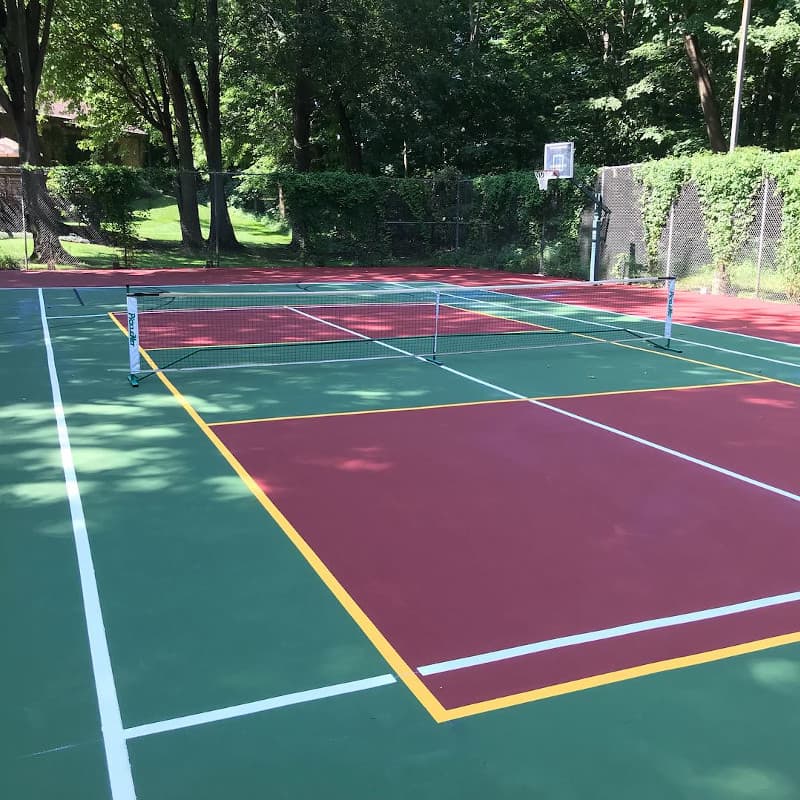
Lighting Considerations for Residential Courts
Pickleball courts near homes almost always require careful lighting planning. Lights extend playability into evening hours, but they also affect neighbors. USA Pickleball recommends a minimum of 30 foot-candles of even lighting across the entire court surface for recreational play.
Key lighting factors:
- Light spillover: Use shielded, directed LED court lights that minimize light trespass onto neighboring properties
- Pole height: Check local zoning for restrictions on accessory structure height, as lighting poles are often regulated
- Timers and controls: Install timers or smart controls to ensure lights aren’t accidentally left on overnight
- HOA rules: Many HOAs have specific restrictions on exterior lighting that you’ll need to address in your approval process
Fencing and Containment
A pickleball court without proper fencing becomes a constant ball-retrieval problem. Standard court fencing is typically chain-link, 10 feet tall, positioned around the full perimeter.
In residential settings, aesthetics matter. Powder-coated or vinyl-coated chain-link looks better than bare galvanized metal. Adding windscreen fabric provides privacy, reduces glare, and gives the court a more finished appearance.
Additional fencing considerations:
- Gate placement should provide logical access without interfering with play
- Tall fencing directly on a property line may create sight-line issues for neighbors and could require a variance
- Windscreen or acoustic fencing can serve double duty as a noise barrier
Talk to Your Neighbors Early
This is the most underrated piece of advice for anyone building a residential pickleball court: talk to your neighbors before you build, not after. People are far more accepting of new developments when they feel informed and consulted rather than surprised.
A simple conversation letting neighbors know what you’re building, where it will be located, what you’re doing to minimize impact, and when you plan to use it can prevent months of conflict. In some cases, neighbors become enthusiastic about the chance to play as well.
For community courts in subdivisions or HOA neighborhoods, consider hosting a brief informational meeting or sending a letter to nearby homeowners before construction begins.
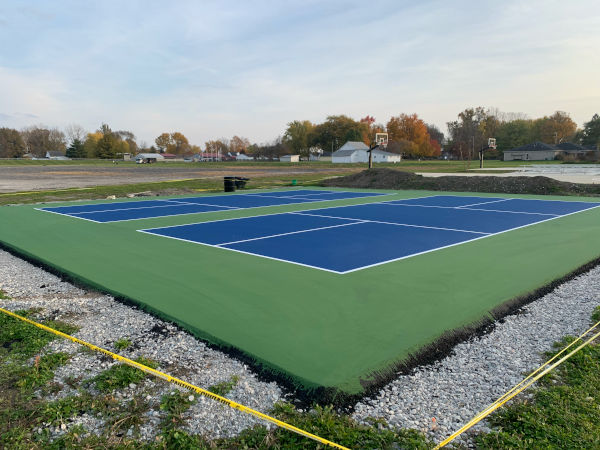
Indiana’s Climate: Plan for All Four Seasons
Indiana courts face real seasonal stress that many other states don’t experience to the same degree. Winters bring freeze-thaw cycles that can crack and heave poorly prepared surfaces. Spring delivers heavy rains that test drainage systems. Summer heat can oxidize inferior coatings. Fall brings leaves and organic debris that promote algae and surface degradation.
A court built to handle Indiana’s climate requires:
- A properly prepared and compacted aggregate base
- Quality asphalt or concrete installed by experienced contractors
- Professional acrylic coatings rated for outdoor sport courts
- Regular court cleaning and crack filling every few years as part of routine maintenance
Court Dimensions and Space Requirements
A regulation pickleball court measures 20 feet wide by 44 feet long, creating a playing area of 880 square feet. However, the total space you need is larger than the playing surface alone.
The USA Pickleball Rule Book recommends a minimum playing surface area of 30 feet by 60 feet (1,800 square feet) to accommodate run-off space for player safety. The preferred size is 34 feet by 64 feet (2,176 square feet), which provides more comfortable buffer zones behind the baselines and along the sidelines.
Before committing to a location on your property, measure carefully and account for setbacks, fencing, and any additional features like benches or a small viewing area. If you’re planning a backyard court installation, getting these measurements right from the start saves time and money.
Work with Indiana’s Pickleball Court Specialists
AG Sports Surfaces has been building and resurfacing sports courts across Indiana for years. We understand the local climate, the regional permitting landscape, and what it takes to build a court that lasts while keeping good relationships with the neighbors intact.
From site evaluation and drainage planning to surface installation and line painting, we handle every step of the process. We also work directly with HOA boards and municipalities for multi-court projects.
Ready to get started? Call us at 765-586-5332 or visit our contact page for a free estimate.
Frequently Asked Questions About Building Pickleball Courts Near Homes in Indiana
Do I need a building permit to build a pickleball court in Indiana?
It depends on your county and municipality. Indiana is a home rule state, so permit requirements vary. Many jurisdictions classify sports courts as accessory structures, which trigger setback, height, and sometimes site plan review requirements. Cities like Indianapolis and Fort Wayne have formal permitting processes, while some rural areas have limited enforcement. Always check with your local building department before starting construction.
How far should a pickleball court be from my neighbor’s house?
Acoustic engineers recommend a minimum of 100 feet from the nearest residential property line for private courts, with 150 feet preferred for HOA or community installations. At distances of 200 feet or more, noise complaints drop significantly. Greater distance is always better for maintaining good neighbor relations.
How loud is a pickleball court?
A pickleball paddle striking the ball registers approximately 70 dBA at 100 feet from the court. The sound falls in the 1,000 to 2,000 Hz frequency range, which is where human hearing is most sensitive. While this is quieter than a lawn mower (90 dBA), the sharp, percussive quality makes pickleball noise more noticeable than other outdoor activities at similar volume levels.
What is the best surface for a backyard pickleball court in Indiana?
Asphalt is the most common base for residential pickleball courts in Indiana due to its lower upfront investment and faster installation. Concrete costs more initially but lasts longer with less maintenance. Both require a professional acrylic coating system to provide proper ball bounce, slip resistance, and UV protection.
How much space do I need for a pickleball court?
The playing surface measures 20 feet by 44 feet, but USA Pickleball recommends a minimum total area of 30 feet by 60 feet (1,800 square feet) including safety buffer zones. The preferred total size is 34 feet by 64 feet (2,176 square feet). You’ll also need to account for setbacks from property lines and space for fencing.
Should I orient my pickleball court north-south?
Yes. USA Pickleball recommends a north-south orientation for outdoor courts to minimize sun glare during morning and late-afternoon play. In Indiana, this orientation works well year-round because the sun’s path across the sky stays consistently east-to-west.