
Indiana has no state, county, or city noise ordinances that specifically regulate pickleball court noise. That means there is no legal requirement to install a sound barrier on your court. However, being a considerate neighbor is reason enough to plan for noise reduction, especially in suburban neighborhoods where homes sit 50 to 100 feet from the playing surface. Pickleball generates a distinctive high-frequency “pop” that can reach 70 to 80 decibels at the court surface and remain audible well beyond 150 feet.
At AG Sports Surfaces, we have helped homeowners, HOAs, municipalities, schools, and private clubs across Indiana build and resurface pickleball courts for over 20 years. Noise management is one of the most common topics we address during the planning phase. This guide covers why pickleball is loud, what your sound mitigation options are, and how to make smart decisions before breaking ground.
Why Is Pickleball Loud?
Pickleball noise is not imaginary. A 2024 study published in the American Journal of Otolaryngology measured average sound levels of 69.1 dBA at areas adjacent to courts, with peak levels reaching 92 dBA on individual strikes. The hard polymer ball striking a composite or graphite paddle creates a sharp, high-frequency crack on contact. Unlike tennis, where a fuzzy ball absorbs much of the sound energy, pickleball produces a percussive “pop” that can travel 100 feet or more in open outdoor environments.
Several factors determine how much noise your court generates:
- Paddle material: Graphite and carbon fiber paddles tend to be louder than polymer-core models
- Ball type: Outdoor balls with smaller holes are harder and louder than indoor balls
- Court surface: Harder surfaces like bare concrete reflect more sound than textured acrylic coatings
- Court location: Open flat areas with no surrounding structures allow sound to travel farther
- Number of courts: Multi-court facilities multiply the acoustic output significantly
According to a civil engineering analysis by EVstudio, pickleball courts generate sound levels between 60 and 70 decibels during typical play, comparable to a normal conversation or a running dishwasher. For context, basketball and playground activity can hit 80 decibels, while nearby traffic ranges from 50 to 90 decibels depending on volume.
Indiana Noise Ordinances and Pickleball: What You Need to Know
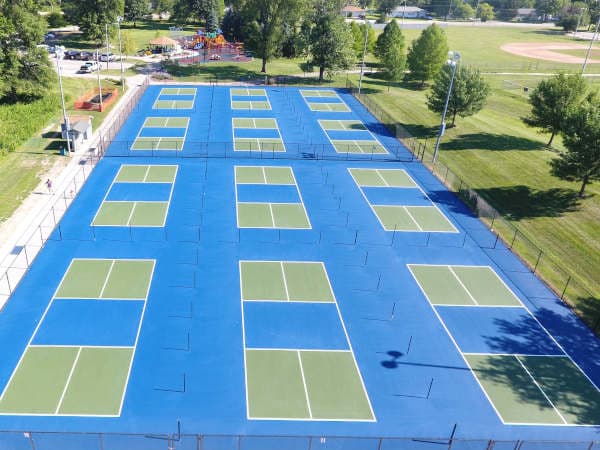
As of 2026, Indiana does not have a single statewide noise ordinance that applies to pickleball courts. There are no county-level or city-level regulations in Indiana that specifically address pickleball court sound levels. This sets Indiana apart from states like Massachusetts and Arizona, where municipalities have actively legislated around pickleball noise thresholds.
This absence of regulation does not mean you should ignore the issue. Even without enforceable sound limits, excessive noise can trigger neighbor complaints, HOA disputes, and general friction in your community. The smarter approach is proactive: plan your court with noise awareness from the start, and you will likely never face a problem.
Before breaking ground on any Indiana court project, we recommend:
- Talking to your neighbors proactively, especially for backyard courts
- Reviewing HOA rules if your property falls within a homeowners association
- Considering setback distance from neighboring homes
- Consulting with a court contractor familiar with local site conditions.
Do You Actually Need a Sound Barrier?
Not every pickleball court in Indiana requires a formal sound barrier. The answer depends on several site-specific factors.
Distance to Neighbors
If your court sits 150 feet or more from neighboring homes, a sound barrier is likely unnecessary. On rural Indiana properties with ample setbacks, noise dissipates naturally before reaching anyone. In suburban neighborhoods with smaller lots, even a 50-foot setback can push sound levels above comfortable thresholds for adjacent residents.
Existing Natural Barriers
Trees, shrubs, hills, and existing fencing can all reduce noise naturally. A dense row of mature evergreens can absorb and deflect sound meaningfully. According to the American Institute of Building Design (AIBD), hedges can reduce pickleball noise by an average of 2.7 decibels, with a maximum reduction of 7.0 decibels for dense, tall plantings. If your property already has natural buffering between the court and neighbors, you may not need additional structures.
Hours and Frequency of Use
A court used occasionally on weekend afternoons is a very different situation from a commercial facility running games from morning to evening. Frequent use increases the likelihood of neighbor complaints and may push your local jurisdiction to eventually adopt mitigation requirements. Planning ahead saves money and relationships.
Sound Barrier and Noise Reduction Options for Indiana Pickleball Courts
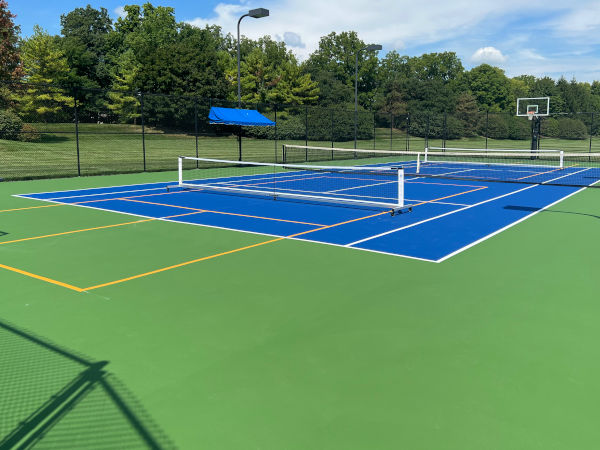
If you do need (or simply want) to reduce noise from your court, several effective options exist. Think of these as “good neighbor” measures that protect your investment and your community relationships.
Acoustic Tiles and Panels
Specialized acoustic tiles designed for outdoor sports courts are one of the most direct solutions for pickleball noise reduction. These panels are made from dense materials like mass-loaded vinyl or composite wood combined with foam insulation. When installed around the perimeter of the court (or just on the side facing neighbors), they can reduce noise levels by 10 to 15 dB, which represents a meaningful reduction in perceived loudness.
PICKLEGLASS Acoustic Fencing
PICKLEGLASS is a transparent acoustic glass system designed specifically for pickleball courts. Designated as an Official Court Builder product by USA Pickleball, this system claims up to 50% noise reduction while maintaining full visibility of the playing surface. It combines the functionality of a sound barrier with the aesthetics of clear fencing, making it a popular choice for communities and private courts where visual openness matters.
Quiet Paddles and Equipment
USA Pickleball launched its “Quiet Category” certification program in late 2024, establishing rigorous acoustic standards for paddles, balls, and accessories. Quiet Category paddles must produce peak readings below 80 dBA and sound frequencies below 600 Hz on impact. According to USA Pickleball, certified quiet paddles deliver more than a 50% reduction in noise compared to standard paddles. Brands like OWL, GAMMA, and others now offer models that meet these thresholds.
Quiet equipment is not a standalone solution for every situation. However, for backyard courts in residential neighborhoods, switching to certified quiet paddles and foam-core balls can make a significant difference in how neighbors perceive your court activity.
Landscaping Buffers
Thick plantings of fast-growing trees or shrubs work as a living sound buffer. Arborvitae, which thrives across Indiana, is a popular choice. While not as immediately effective as engineered panels, landscaping buffers improve over time and add visual privacy. A dense hedge row planted 6 to 8 feet from the court perimeter can reduce perceived noise while improving the aesthetics of your property.
Windscreen and Court Surround Fencing
Heavy-duty windscreen fabric on chain-link fencing around the court provides some sound deflection. It will not dramatically reduce noise, but it is a low-cost addition that also improves ball containment and court aesthetics.
Berms and Grade Changes
For new court installations, grading a slight earthen berm on the side facing neighbors can help block and absorb sound. This is most practical when planning a court from scratch. Adding a berm after construction is difficult and costly.
Sound Barrier Comparison: Effectiveness and Best Use
| Option | Noise Reduction | Best For |
| Acoustic Tiles/Panels | 10-15 dB | Courts near homes, HOA facilities |
| PICKLEGLASS | Up to 50% | Communities wanting visibility + sound control |
| Quiet Paddles/Balls | 3-7 dB (50%+ perceived) | Backyard courts, HOA rules, early/late play |
| Landscaping Buffers | 2.7-7 dB | Long-term solution, visual privacy |
| Windscreen Fencing | Minimal | Budget option, ball containment |
| Earthen Berms | Moderate | New builds with flexible grading |
Court Surface Choices That Reduce Noise
At AG Sports Surfaces, we specialize in acrylic sports court coatings applied over asphalt or concrete. While no coating will eliminate pickleball noise entirely, the right surface system makes a modest difference. Textured acrylic coatings provide slightly more “give” than bare concrete, and the surface texture affects ball-surface interaction and bounce sound. Learn more about our pickleball court installation services to see how we approach surface selection.
More significantly, the quality and evenness of your base affects how sound resonates from the surface. A well-installed, smooth base with proper acrylic resurfacing is less likely to produce additional noise from uneven ball bounces or surface irregularities. Courts with cracking, pooling, or surface wear will often sound louder simply because the ball interacts with an inconsistent surface.
If your existing court needs restoration, our pickleball court resurfacing services can restore a smooth, consistent playing surface that minimizes unnecessary noise.
Planning Your Indiana Pickleball Court the Right Way
The best time to address noise is during the planning phase, not after your neighbors file complaints. A 2024 siting study by Weston & Sampson found that setback distances of 100 to 150 feet from residential property lines combined with acoustic barrier fencing rated for 15 to 25 dBA reduction can bring court noise well within acceptable ranges for most communities.
Here is a practical checklist for Indiana court builders:
- Assess setback distance: Maximize the gap between your court and the nearest home
- Orient the court strategically: Position the court so the longest sides face away from neighbors when possible
- Plan drainage and grading together: If you are grading the site anyway, consider adding a berm for sound blocking
- Choose the right surface: Textured acrylic coatings reduce surface-level noise compared to bare concrete
- Budget for barriers if needed: Acoustic tiles, PICKLEGLASS, or landscaping should be included in initial project costs
- Encourage quiet equipment: Post signage recommending quiet paddles and balls, especially during early morning and evening hours
AG Sports Surfaces works with homeowners, HOAs, schools, and parks departments across Indiana to plan and install pickleball courts that work for your property and your neighbors. We evaluate your site, discuss noise considerations, and recommend the right court design, sound mitigation approach, and pickleball court considerations for your situation.
Frequently Asked Questions
Are there noise laws for pickleball courts in Indiana?
No. As of 2026, Indiana does not have any state, county, or municipal noise ordinances that specifically address pickleball courts. While general noise ordinances exist in some cities, none currently target pickleball. This does not eliminate the importance of being a good neighbor and planning your court with sound in mind.
How loud is a pickleball court in decibels?
A standard outdoor pickleball court during active play generates average noise levels between 60 and 70 dBA at courtside. Peak levels from individual paddle strikes can reach 90 dBA or higher. At 50 feet from the court, sound typically drops to roughly 50 to 65 dBA, comparable to a normal conversation.
What is PICKLEGLASS and does it work for noise reduction?
PICKLEGLASS is a transparent acoustic glass fencing system designed specifically for pickleball courts. Recognized by USA Pickleball as an Official Court Builder product, the system claims up to 50% noise reduction while keeping the court fully visible. It is one of the most effective barrier options available for courts in noise-sensitive locations.
Do quiet pickleball paddles actually reduce noise?
Yes. USA Pickleball’s Quiet Category certification requires paddles to produce peak readings below 80 dBA and sound frequencies below 600 Hz. Certified quiet paddles deliver more than 50% noise reduction compared to standard paddles. While not a complete solution on their own, they are an easy and affordable step toward reducing court noise.
How far should a pickleball court be from neighboring homes?
There is no legal setback requirement in Indiana for pickleball courts. However, industry guidance suggests a minimum of 100 to 150 feet from residential property lines for courts without sound barriers. Courts with acoustic fencing or natural buffers can be placed closer while still maintaining acceptable noise levels for neighbors.
Does the court surface affect pickleball noise?
Yes, though the effect is modest. Textured acrylic coatings provide slightly more cushion than bare concrete, reducing the sharpness of the ball-surface interaction. A smooth, well-maintained surface also minimizes irregular bounces that can amplify noise. AG Sports Surfaces applies professional-grade acrylic sport court coatings designed for optimal playability and noise management.
Ready to Build Your Indiana Pickleball Court the Right Way?
AG Sports Surfaces has over 20 years of experience building and resurfacing sports courts across Indiana. We work with homeowners, HOAs, schools, parks departments, and private clubs to design courts that perform well and keep the peace with neighbors. From site evaluation to surface selection to sound mitigation planning, we handle every detail. Call us today at 765-586-5332 for a free estimate.